Persian Cat Air Travel: What Most Owners Don’t Know
Planning Persian cat air travel is very different from booking a normal pet flight.
Persian and Himalayan cats are brachycephalic breeds, meaning their skulls and facial structures are shorter and flatter than those of many other cats. This can affect breathing, temperature regulation and their ability to cope with the stress of transportation.
That does not automatically mean your Persian or Himalayan cat cannot fly.
However, airline policies can be stricter for flat-faced cats, particularly when travelling in the cargo hold. Depending on the airline, route, season, aircraft and your cat’s health, you may need to consider in-cabin travel, specialised pet relocation, climate-controlled transportation or private charter options.
If you’re relocating your cat to Dubai, London or the USA, the biggest mistake is assuming that your cat’s airline ticket is the only thing you need to arrange.
There are actually three separate things to plan:
1. Your cat’s health and suitability for travel
2. The airline’s breed and transportation rules
3. The destination country’s import requirements
This guide explains all three.
Quick answer: Persian and Himalayan cats can travel internationally in many circumstances, but their flat-faced anatomy can make air travel more challenging. Airline acceptance is not universal, and cargo restrictions may apply. Before booking, confirm the airline’s current policy, have your veterinarian assess your cat, and prepare the destination-specific import documents.
Table of Contents
If you are using a WordPress Table of Contents plugin, configure it to automatically display the H2 and H3 headings below.
- Why Is Persian Cat Air Travel Different?
- Can Persian and Himalayan Cats Fly on a Plane?
- Why Are Persian Cats Considered Brachycephalic?
- Can Persian Cats Travel in Cabin?
- Can Persian Cats Travel in Cargo?
- What Is the Safest Way to Fly With a Persian Cat?
- Persian Cat Air Travel to Dubai
- Persian Cat Air Travel to London
- Persian Cat Air Travel to the USA
- Persian Cat Flight Preparation Checklist
- Common Mistakes Owners Make
- Frequently Asked Questions
- Pet Relocation for Persian and Himalayan Cats
Why Is Persian Cat Air Travel Different?
The biggest difference is the flat-faced anatomy of Persian and Himalayan cats.
Persians and Himalayans are brachycephalic breeds. Some individuals have more pronounced breathing limitations than others, so breed alone does not determine whether a particular cat is fit to travel.
Air travel can introduce additional stress through:
- Airport noise
- Handling
- Time inside a carrier
- Temperature changes
- Long journeys
- Layovers
- Unfamiliar surroundings
- Dehydration
- Anxiety
For a healthy cat, these factors may be manageable. For a cat with significant airway obstruction or other health problems, they can become more concerning.
This is why Persian cat air travel should always be planned around the individual cat rather than simply the breed.
Can Persian and Himalayan Cats Fly on a Plane?
Yes, Persian and Himalayan cats can fly in many circumstances, but whether they are accepted depends on the airline, route, aircraft and method of transportation.
Some airlines permit cats in the cabin if they meet specific carrier and weight requirements.
Other airlines may restrict certain brachycephalic breeds from cargo transportation.
Some airlines may also have different rules for:
- Cabin travel
- Checked baggage
- Manifest cargo
- Connecting flights
- Seasonal temperatures
- Specific aircraft
- International routes
This means there is no universal answer to the question:
“Can my Persian cat fly?”
The correct answer is:
Check the exact airline, route, aircraft and travel method before booking.
A flight that accepts one Persian cat may not necessarily accept another on a different route.
Why Are Persian Cats Considered Brachycephalic?
A brachycephalic animal has a shortened skull and flattened facial structure.
Persian and Himalayan cats are among the breeds commonly described as brachycephalic.
Their anatomy can include:
- Shortened nasal passages
- Narrow nostrils
- A compressed upper airway
- Reduced airflow
- Difficulty regulating body temperature
- Increased sensitivity to heat and stress
The severity varies significantly between individual cats.
Some cats have relatively mild anatomical changes, while others can have more pronounced airway limitations.
This is why a veterinary assessment before Persian cat air travel is important.
Your veterinarian can assess your cat’s general health and discuss whether air travel is appropriate based on its individual condition.
Can Persian Cats Travel in Cabin?
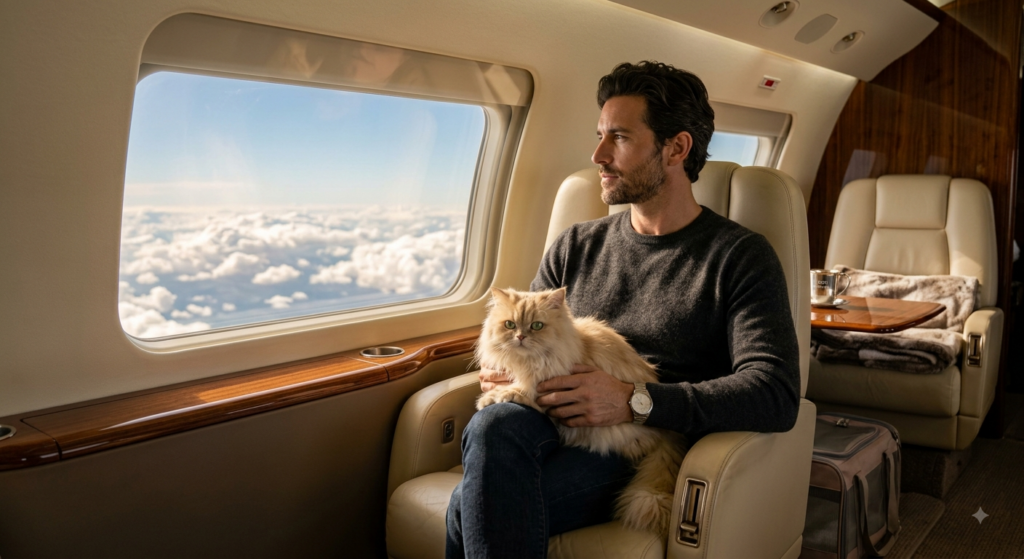
In-cabin travel can be an option for some Persian and Himalayan cats, provided the airline allows the breed and the cat meets its cabin requirements.
This can be attractive because your cat remains near you instead of travelling separately.
However, cabin travel still has restrictions.
Airlines may specify:
- Maximum combined pet and carrier weight
- Maximum carrier dimensions
- Approved carrier type
- Number of pets permitted in the cabin
- Advance booking requirements
- Breed restrictions
- Destination restrictions
Some airlines use weight limits around 6–9 kg including the carrier, but there is no universal international standard.
Therefore, don’t assume that because your Persian cat is small enough to fit under the seat, it will automatically be accepted.
The airline must approve the pet, carrier, route and travel method.
What Should the Carrier Be Like?
For cabin travel, the carrier should meet the airline’s requirements while providing adequate ventilation and allowing your cat to remain comfortably positioned.
Before the flight:
- Introduce your cat to the carrier gradually.
- Allow your cat to spend time inside it at home.
- Take short practice journeys.
- Avoid last-minute carrier training.
- Keep the carrier well ventilated.
- Use an absorbent liner.
- Carry essential documents separately.
Do not modify a carrier in a way that compromises its structure or ventilation.
Can Persian Cats Travel in Cargo?
Sometimes, but this is one of the areas where Persian cat air travel becomes more complicated.
Airline cargo policies for brachycephalic cats vary significantly.
Some airlines may restrict or prohibit Persian and Himalayan cats from cargo because of concerns associated with their short-nosed anatomy.
Other carriers may accept them under specific conditions.
Some may impose:
- Seasonal restrictions
- Temperature restrictions
- Veterinary requirements
- Breed restrictions
- Route restrictions
- Aircraft restrictions
A cargo policy can also change, so an old experience or recommendation from another pet owner should not be treated as confirmation for your current journey.
Never Assume a Confirmed Pet Booking Guarantees Acceptance
One of the most important things owners don’t realise is that having a pet reservation does not necessarily mean every requirement has been satisfied.
The airline may still verify:
- Breed
- Carrier
- Documents
- Health certificate
- Temperature conditions
- Route
- Aircraft
- Transit requirements
For this reason, professional pet relocation planning can reduce the risk of discovering a problem at the airport.
What Is the Safest Way to Fly With a Persian Cat?
There is no single travel method that is safest for every Persian or Himalayan cat.
The appropriate option depends on:
- Your cat’s health
- Airway condition
- Age
- Weight
- Temperament
- Route
- Season
- Airline
- Aircraft
- Transit time
- Destination requirements
For some cats, in-cabin travel may be preferable because the owner can remain nearby.
For larger or more complex international relocations, owners may need to consider specialist pet relocation services or private charter arrangements.
The goal should not simply be to find the cheapest flight.
The goal is to create a journey that is appropriate for the individual cat and compliant with airline and destination requirements.
Persian Cat Air Travel to Dubai
Dubai is one of the most important destinations to plan carefully for flat-faced cats.
The UAE requires imported cats and dogs to meet specific veterinary and documentation requirements. UAE regulations include requirements such as a prior import permit, permanent microchip identification and veterinary documentation.
The UAE’s rules also require imported cats and dogs to be transported according to applicable IATA pet-transport standards.
What Documents May Be Required for Dubai?
Depending on your circumstances, your relocation may involve:
- Import permit
- Microchip
- Vaccination records
- Veterinary health certificate
- Rabies-related documentation
- Laboratory testing where applicable
- Airline documentation
- Customs and arrival procedures
Because requirements can depend on the origin country and current regulations, confirm the latest UAE requirements before travelling.
UAE Government Pet Import Information
Why Is Dubai More Challenging for Persian Cats?
Temperature is a major planning consideration.
Persian and Himalayan cats may be more vulnerable to heat-related stress because of their brachycephalic anatomy.
That means you should consider more than just the flight.
Your journey could involve:
Home → Vehicle → Airport → Check-in → Security/handling → Aircraft → Arrival → Customs → Ground transfer → Home
The ground transportation and airport waiting periods should therefore be included in your planning.
For Dubai relocations, see our pet relocation services to Dubai and our guide to pet-friendly private jet travel in Dubai.
Persian Cat Air Travel to London
Moving a Persian or Himalayan cat to London requires you to satisfy both airline requirements and UK pet-entry rules.
The UK government provides specific requirements for bringing cats into Great Britain, and the required documentation depends on the country from which the pet is travelling.
Depending on the route and origin, requirements may involve:
- Microchip
- Rabies vaccination
- Appropriate pet travel documentation
- Animal Health Certificate where applicable
- Approved travel arrangements
- Airline documentation
- Entry-point requirements
UK guidance is updated periodically, so owners should check the current requirements before departure. The government also updated its carrier guidance in May 2026, including changes concerning Animal Health Certificate templates from October 2026.
UK Government Pet Travel Guidance
Can a Persian Cat Fly to London in Cabin?
Possibly.
The answer depends on the airline and route.
One of the biggest mistakes is assuming that an airline’s general “pets allowed” policy automatically means Persian cats can travel in the cabin.
You need to confirm:
Breed + cabin eligibility + carrier dimensions + route + aircraft + destination requirements.
If the airline does not offer a suitable cabin option, professional pet relocation or alternative aviation arrangements may need to be considered.
Persian Cat Air Travel to the USA
The USA is different from Dubai and the UK because federal and state-level requirements can both matter.
The CDC states that cats arriving in the United States must appear healthy, and cats are subject to inspection at ports of entry. CDC does not require proof of rabies vaccination for cats as a federal import requirement, although it recommends that cats be vaccinated and the destination state may have additional requirements.
That means owners should check both:
Federal requirements + state requirements
before travelling.
CDC – Bringing an Animal Into the United States
What Makes Persian Cat Travel to the USA Complicated?
The flight itself is only one part of the relocation.
You may also need to coordinate:
- Airline approval
- Carrier requirements
- Veterinary documents
- Microchip information
- Vaccination records
- Destination-state requirements
- Customs or inspection procedures
- Ground transportation
If your Persian cat is travelling from another country through a connecting airport, the rules of the transit location and airline can also affect the itinerary.
Persian Cat Flight Preparation Checklist
Start preparing well before the departure date.
1. Book a Veterinary Assessment
Ask your veterinarian to assess your cat’s general health and discuss whether the planned journey is appropriate.
For a Persian or Himalayan cat, discuss any history of:
- Noisy breathing
- Exercise intolerance
- Excessive panting
- Heat sensitivity
- Respiratory problems
- Previous anaesthetic concerns
2. Confirm the Airline’s Breed Policy
Don’t rely on a generic pet-policy page.
Ask specifically:
“Do you accept Persian/Himalayan cats on this exact route and aircraft, and are they permitted in cabin or cargo?”
Get confirmation before finalising the itinerary.
3. Check the Carrier Requirements
Measure the carrier before purchasing it.
Check:
- Length
- Width
- Height
- Weight
- Ventilation
- Material
- Under-seat compatibility
4. Prepare the Documentation
Create a dedicated document folder containing:
- Microchip details
- Vaccination records
- Veterinary certificate
- Import permit
- Health certificate
- Airline confirmation
- Destination documents
- Owner identification
- Copies of all paperwork
5. Plan the Ground Transportation
For a brachycephalic cat, airport transportation should be part of the pet relocation plan.
Use appropriate temperature-controlled transportation where required, particularly for hot-weather destinations.
6. Avoid Last-Minute Changes
International pet travel involves multiple parties:
Veterinarian + Government authorities + Airline + Airport + Customs + Ground transport
A change in one part can affect the entire itinerary.
7 Mistakes Owners Make When Flying With Persian Cats
Mistake 1: Assuming All Airlines Treat Persian Cats the Same
They don’t.
Breed policies, cabin rules and cargo restrictions can differ between carriers.
Mistake 2: Booking the Flight Before Checking Pet Rules
Your own passenger ticket is not enough.
Your pet needs to be accepted separately under the airline’s pet policy.
Mistake 3: Assuming Cabin Travel Is Automatically Safe
Cabin travel avoids some cargo-related issues, but your cat still experiences:
- Airport stress
- Carrier confinement
- Noise
- Temperature changes
- A long journey
Your veterinarian should assess whether your individual cat is suitable for travel.
Mistake 4: Ignoring the Transit Airport
A flight with one connection may look cheaper or shorter, but the transit airport can introduce additional handling and documentation requirements.
Mistake 5: Preparing Documents at the Last Minute
Some documents have specific validity periods.
Start the process early.
Mistake 6: Focusing Only on the Flight
The total journey may last significantly longer than the flight itself.
Think about the entire door-to-door relocation.
Mistake 7: Assuming a Previous Year’s Rules Still Apply
Pet travel regulations and airline policies can change.
Always verify the current requirements for your departure date.
Persian Cat Air Travel vs Professional Pet Relocation
| Option | Best For | Advantages | Considerations |
|---|---|---|---|
| Owner-managed travel | Simple routes | Lower service cost | Owner manages paperwork |
| In-cabin travel | Eligible smaller cats | Cat stays with owner | Airline restrictions |
| Professional relocation | Complex international routes | Documentation and logistics support | Service fee |
| Flight nanny/pet escort | Owners unable to accompany pet | Dedicated handler | Availability and cost |
| Private charter | Multiple pets or complex requirements | Flexible cabin-based travel | Premium cost |
Frequently Asked Questions About Persian Cat Air Travel
Can Persian cats fly on airplanes?
Yes, Persian cats can fly in many circumstances. However, airline policies vary and some carriers restrict brachycephalic cats, particularly from cargo travel. Always confirm the breed, route and travel method with the airline before booking.
Can Himalayan cats fly internationally?
Yes. Himalayan cats can travel internationally when the airline and destination permit it. Because Himalayans are also brachycephalic, owners should consider their individual health and check the airline’s current restrictions.
Are Persian cats banned from cargo?
Some airlines restrict or prohibit Persian cats from cargo, while others may accept them under specific conditions. There is no universal worldwide cargo policy for Persian cats.
Can a Persian cat travel in the cabin?
Possibly. If the airline permits cats in the cabin and your Persian meets its carrier, weight and route requirements, cabin travel may be available.
Is flying dangerous for Persian cats?
Air travel can present additional challenges for brachycephalic cats, particularly if they have significant airway or respiratory problems. The risk depends on the individual cat, journey and travel conditions. Discuss the planned trip with your veterinarian before booking.
Should I sedate my Persian cat before a flight?
Do not give your cat a sedative simply because it is travelling without first discussing it with your veterinarian.
Sedation can affect an animal’s ability to respond to changes during transportation and may introduce additional risks. Your veterinarian should advise you about whether any medication is appropriate for your individual cat.
How do I move a Persian cat to Dubai?
Start by checking the UAE’s current import requirements, obtaining the necessary documentation and confirming the airline’s policy for Persian cats. Then plan the entire journey, including airport transfers and arrival procedures.
How do I move a Persian cat to London?
Check the latest Great Britain pet-entry requirements based on your country of departure, then confirm the airline’s policy for Persian cats. Prepare the required microchip, vaccination and health documentation well in advance.
How do I move a Persian cat to the USA?
Check the CDC requirements for cats entering the United States and any additional requirements imposed by your destination state. Then confirm your airline’s Persian-cat policy and prepare the necessary veterinary and travel documentation.
What is the best airline for Persian cats?
There is no single best airline for every Persian cat.
The right choice depends on:
- Origin
- Destination
- Direct vs connecting flight
- Cabin availability
- Breed restrictions
- Carrier rules
- Season
- Your cat’s health
The best flight is the one that meets the airline’s current pet policy and provides an appropriate itinerary for your individual cat.
Moving a Persian or Himalayan Cat? Plan the Journey Around Your Pet
Persian and Himalayan cats can travel internationally, but their flat-faced anatomy means that pet relocation should never be treated like ordinary luggage.
Whether you’re moving from Dubai to London, London to the USA, India to Dubai, or another international route, start by assessing your cat’s health, then confirm the airline’s current policy and destination requirements.
At PetJet Express, we can help coordinate the different parts of an international pet relocation, including flight planning, pet documentation, airport coordination, ground transportation and specialised travel arrangements.
If you’re planning Persian cat air travel to Dubai, London or the USA, contact our team for a route-specific relocation plan.