Flying with pets sounds simple until you actually try to book the ticket. Between cabin restrictions, cargo-only countries, breed bans, and paperwork deadlines, the rules change completely depending on where you’re flying from and where you’re landing.
This guide breaks down exactly what to expect when flying with pets through three of the world’s biggest pet travel corridors — Dubai, London, and the United States — including which airlines allow it, how much it really costs, and the documents you’ll need before you get anywhere near check-in.
Table of Contents
- How Pets Fly: Cabin, Checked Baggage & Cargo
- Flying with Pets to Dubai (UAE)
- Flying with Pets in London & the UK
- Flying with Pets in the US
- Cost Snapshot: Dubai vs. London vs. US
- Frequently Asked Questions
How Pets Fly: Cabin, Checked Baggage & Cargo
Before comparing specific countries, it helps to understand the three ways an animal can travel when flying with pets by air:
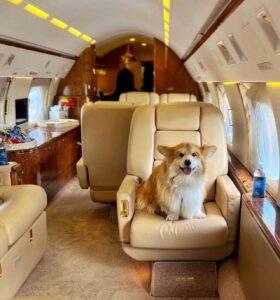
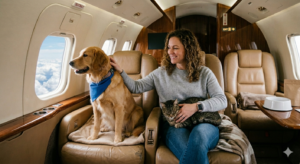
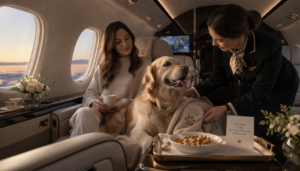
- In-cabin: Small dogs and cats that fit in an approved soft carrier under the seat in front of you. This is the cheapest and least stressful option, but availability is limited to a handful of spots per flight.
- Checked baggage: Larger pets travel in the aircraft’s pressurized, climate-controlled hold on the same flight as their owner. Fewer airlines still offer this to the general public.
- Manifest cargo: The pet is booked separately through the airline’s cargo division and may not travel on the same flight as the owner. This is mandatory for certain countries and pet sizes, regardless of what the airline normally allows elsewhere in its network.
Which option applies to you depends on your pet’s size and breed, the airline, and — most importantly — the destination country’s own import rules, which override anything the airline permits on other routes. For the official baseline rules, see the US Department of Transportation’s guidance on flying with pets.
Flying with Pets to Dubai (UAE)
Dubai is one of the more complex corridors for flying with pets, and the rules catch a lot of first-time movers off guard.
The key rule: under UAE regulations, pets cannot enter Dubai International Airport (DXB) as an in-cabin or checked pet — every dog, cat, and bird must arrive as manifest cargo through a dedicated cargo terminal rather than the passenger terminal.
- Emirates: Does not carry pets in the cabin (falcons are the only exception, on select Pakistan routes). Dogs and cats travel as checked baggage on some outbound routes under 17 hours, or as SkyCargo manifest cargo. Seasonal embargoes apply to snub-nosed (brachycephalic) breeds during UAE summer months.
- Etihad Airways (Abu Dhabi): The only Gulf carrier currently allowing small dogs and cats in the cabin, with pet fees starting from roughly $399. Pets must be under 8kg including the carrier, with bookings submitted at least seven days ahead. Etihad flies into Abu Dhabi (AUH), not Dubai (DXB).
- flydubai: Pets can only travel as cargo — no cabin or checked-baggage option.
- Qatar Airways Cargo: A commonly used alternative, routing through Doha with a well-regarded live-animal handling facility.
Typical costs: Manifest cargo shipments into or out of Dubai commonly range from $1,500–$5,000+ one way depending on crate size, weight, and routing, while Etihad’s in-cabin option starts near $399 for eligible small pets. Shared charter flights typically run $8,000–$12,000 per passenger seat and are increasingly used for large dogs or urgent relocations. (Internal link: add a link here to your agency’s/client’s Dubai pet relocation or aviation partner service page.)
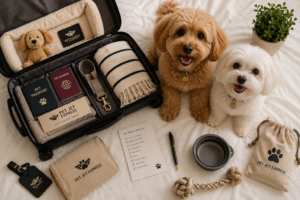
Documents typically required: MOCCAE export permit, UAE Health Certificate, proof of rabies vaccination, and a health certificate issued shortly before travel, plus destination-country import paperwork.
Flying with Pets in London & the UK
The UK has one of the strictest — and most misunderstood — systems for flying with pets of any major travel corridor.
The key rule: every pet entering Great Britain must arrive as manifest cargo. No commercial airline currently accepts pets in the cabin or as checked baggage into the UK, with the sole exception of recognized assistance dogs — even on airlines that carry pets in the cabin elsewhere in their network. Full official requirements are listed on GOV.UK’s pet travel guidance.
- British Airways: Does not accept pets in the cabin or as checked baggage on any route. All shipments go through IAG Cargo, generally booked via an IPATA-certified pet shipping agent rather than directly with the airline.
- American Airlines, Delta, United: All confirm pets cannot fly in the cabin or as checked baggage into the UK, despite normally allowing pets on other transatlantic routes.
- The cabin workaround: The only way to fly a pet in the cabin directly into the UK is via an approved private charter, since commercial in-cabin travel isn’t an option on UK-bound routes.
- Arrival points: Heathrow charges roughly £260 per airway bill for pet processing, while Manchester’s Animal Reception Centre runs closer to £100 plus a small per-kg fee — worth checking if your route allows either arrival point.
Typical costs: Cargo shipments into or out of the UK commonly start around $1,500–$2,000+ one way, plus separate IPATA pet shipper fees of roughly $200–$500+ for customs handling and collection. (Internal link: add a link here to your agency’s/client’s UK pet import or relocation concierge page.)
Documents typically required: ISO-compliant microchip, valid rabies vaccination (with the standard waiting period for first-time vaccinations), a health certificate or Animal Health Certificate (AHC), and — for dogs — tapeworm treatment administered in a specific window before travel.
Flying with Pets in the US
The United States is comparatively the most accessible of the three markets for domestic travel, but international routes still carry real complexity.
- Domestic in-cabin travel: Most major US carriers allow small dogs and cats in the cabin on domestic routes for a fee, provided the pet and carrier fit under the seat. Many airlines have scaled back checked-pet and cargo programs, so in-cabin is increasingly the only option for most domestic travelers.
- International routes: Airlines including American Airlines allow dogs and cats to enter the US as checked pets on select routes, but the same airlines don’t accept pets — cabin or checked — on flights out of the UK, since UK rules require manifest cargo regardless of the airline’s normal policy.
- CDC dog import rules: All dogs entering the US must be microchipped and, since August 2024, are subject to a CDC Dog Import Form completed in advance. Dogs from countries considered high-risk for rabies face additional age and vaccination requirements.
- Breed and weather restrictions: Brachycephalic breeds — bulldogs, pugs, Persian cats, and similar — are frequently barred from cargo or checked travel, and airlines apply heat embargoes that suspend cargo pet transport during high ground temperatures, common in peak summer months.
Typical costs: Domestic in-cabin pet fees generally run $95–$200 each way per airline. International cargo shipments commonly start at $1,000–$3,000+ one way depending on size, route, and season. (Internal link: add a link here to your agency’s/client’s US pet travel or import assistance page.)
Documents typically required: ISO microchip, rabies vaccination records, a health certificate issued within 10 days of travel, and the CDC Dog Import Form for international arrivals.
Cost Snapshot: Dubai vs. London vs. US
| Route/Market | In-Cabin Available? | Typical Cargo Cost (one way) | Notes |
|---|---|---|---|
| Dubai (DXB) | No (Emirates/flydubai) — Etihad (AUH) only, from ~$399 | $1,500–$5,000+ | Manifest cargo mandatory into DXB; seasonal brachycephalic embargoes |
| London/UK | No (assistance dogs only) | $1,500–$2,000+ plus $200–$500 shipper fee | Manifest cargo mandatory for all pets; IPATA agent usually required |
| United States (domestic) | Yes, most major carriers | $95–$200 (in-cabin fee) | Cargo/checked options increasingly limited |
| United States (international) | Limited, route-dependent | $1,000–$3,000+ | CDC Dog Import Form required since Aug 2024 |
<a name=”faq”></a>
Frequently Asked Questions
Can dogs fly in the cabin to Dubai? No commercial airline currently allows pets in the cabin on flights landing at Dubai International Airport (DXB). Etihad allows small pets in the cabin, but only on flights to Abu Dhabi (AUH), a different airport.
Can dogs or cats fly in the cabin to London or the UK? No. Every pet entering the UK must travel as manifest cargo, with the sole exception of recognized assistance dogs. The only way to fly a pet in the cabin directly into the UK is via a private charter flight.
Do all pets need a microchip when flying with pets internationally? Yes. An ISO-compliant 15-digit microchip is a standard requirement for international pet travel into the UAE, UK, and US, and is typically required before any vaccination or health certificate will be accepted.
How much does it cost to fly a dog from the US to the UK? Because pets must travel as manifest cargo into the UK, costs typically start around $1,500–$2,000 for the flight itself, plus a separate pet shipping agent fee of roughly $200–$500 for UK-side customs handling.
Are there banned dog breeds for flying? Brachycephalic (snub-nosed) breeds such as bulldogs, pugs, and boxers face the most restrictions — often barred from cargo travel due to breathing risk — and some countries maintain outright import bans on specific breeds.
What is the CDC Dog Import Form? It’s a US entry requirement introduced in 2024 that must be completed online before a dog arrives in the United States, in addition to standard microchip and rabies vaccination requirements.
Final Thoughts
The single biggest mistake people make when flying with pets is assuming an airline’s general pet policy applies everywhere in its network — it doesn’t. Dubai and London both override normal airline flexibility with destination-specific manifest cargo rules, while the US remains comparatively pet-friendly for domestic in-cabin travel but tightens up considerably for international arrivals. Start with your destination country’s rules first, then work backward to airline options — not the other way around.